📞 +91 9262343434

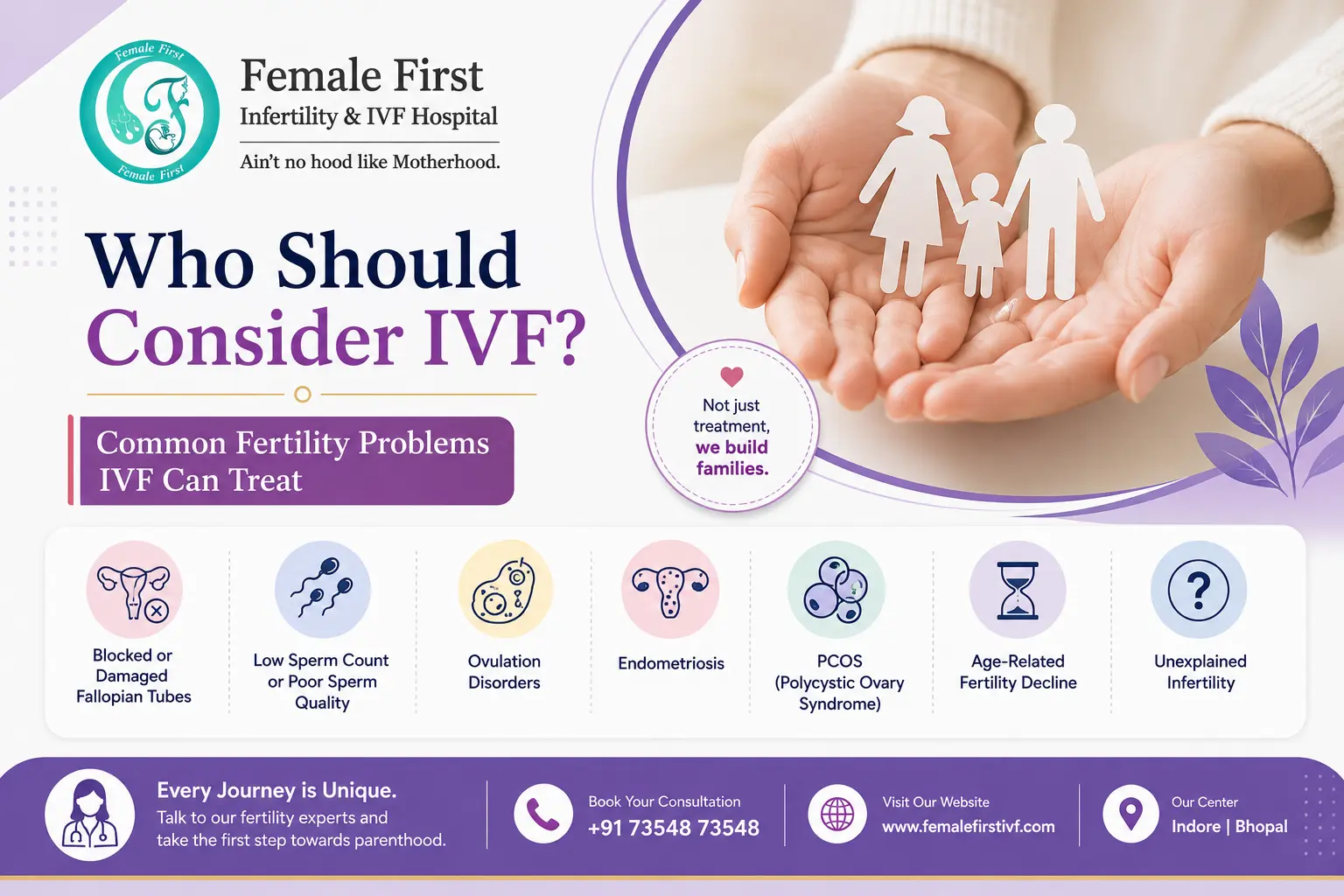
IVF is often pictured as the last resort — the treatment couples reach after years of everything else failing. That picture is outdated. For some medical conditions, IVF is not the last option but the first correct one, and recognising those situations early saves couples years of frustration, money spent on treatments that could not have worked, and precious biological time.
This guide explains exactly who benefits from IVF: the specific fertility problems it treats, why it works when natural conception cannot, and — just as importantly — the situations where simpler treatments deserve a chance first.
The Basic Rule: When to Seek a Fertility Evaluation
Before any talk of treatment, know the timeline doctors use worldwide:
- Under 35: see a specialist after 12 months of regular, unprotected attempts without pregnancy
- 35 or older: after 6 months
- Immediately, at any age, if you already know of a relevant condition — irregular or absent periods, a history of pelvic infection or surgery, known endometriosis, a previous ectopic pregnancy, or an abnormal semen report
An evaluation is not a commitment to IVF. It is simply the diagnosis that tells you which treatment, if any, your situation actually needs. Infertility is far more common than the silence around it suggests — roughly one in six adults worldwide experiences it, according to the World Health Organization — and the couples who resolve it fastest are almost always the ones who got evaluated soonest.
Fertility Problems IVF Can Treat
1. Blocked or Damaged Fallopian Tubes
This is the clearest-cut indication for IVF that exists. Natural conception requires the egg and sperm to meet inside the fallopian tube; if the tubes are blocked by past infection, damaged by an ectopic pregnancy, affected by pelvic surgery, or tied through sterilisation, that meeting simply cannot happen — and no medicine, timing method, or IUI cycle can change it. IVF bypasses the tubes entirely: eggs are retrieved directly from the ovaries, fertilised in the lab, and the embryo is placed directly into the uterus. For tubal factor infertility, IVF is not one option among many; it is the treatment designed for exactly this problem, and couples with healthy eggs, sperm, and uterus in this category are often among the best responders.
2. Male Infertility — From Low Counts to Zero Sperm in the Ejaculate
Male factors contribute to infertility in nearly half of all couples, and modern IVF handles the full spectrum:
- Low count, poor motility, or abnormal morphology: with ICSI treatment in Surat and at advanced labs, a single healthy sperm is selected and injected directly into each egg, so even a handful of good sperm can be enough.
- No sperm in the ejaculate (azoospermia): in many men, sperm are still being produced or are present in the reproductive tract and can be retrieved surgically. Depending on the cause, doctors use PESA treatment in Surat centres (needle retrieval from the epididymis), MESA treatment in Surat units (microsurgical epididymal retrieval), or testicular procedures like TESA and TESE — and the retrieved sperm are used with ICSI.
The practical message for men: an abnormal semen report, even a report showing zero sperm, is the beginning of a treatment conversation, not the end of the road to fatherhood.
3. Women Above 35
Age is not a disease, but it is the strongest single influence on fertility, because egg quality and quantity decline steadily and the decline accelerates after 35. IVF helps here in three ways: controlled stimulation matures multiple eggs in one cycle instead of one, the lab can observe which embryos develop best, and genetic testing can be added where appropriate to select chromosomally normal embryos. IVF cannot turn back the biological clock — we have covered honest age-wise numbers in our guide to the IVF success rate in India — but it meaningfully concentrates your chances at an age when each passing year matters.
4. PCOS That Has Not Responded to Simpler Treatment
Here an honest correction to what many websites imply: PCOS alone is not an automatic IVF indication. Most women with PCOS conceive with far simpler help — lifestyle correction, ovulation-inducing medication, or IUI. IVF enters the picture when those approaches have been properly tried and have not worked, or when PCOS is combined with another factor such as tubal damage or male infertility. When IVF is used for PCOS, it comes with a specific advantage and a specific caution: these ovaries typically produce many eggs (good for embryo numbers), but they are also more sensitive to stimulation, so protocols must be carefully tailored to avoid over-response. For background on the condition itself, MedlinePlus’s PCOS resource is a reliable reference.
5. Endometriosis
Endometriosis — tissue similar to the uterine lining growing outside the uterus — can distort pelvic anatomy, affect egg quality, and interfere with implantation, and it often goes undiagnosed for years behind “normal period pain.” For mild cases, simpler treatments may work; for moderate to severe disease, IVF offers substantially better odds than continuing natural attempts. Treatment is often sequenced: laparoscopic surgery in Surat and at advanced endoscopy units can remove significant endometriotic tissue or cysts first, and IVF follows on improved ground. If painful periods, pain during intercourse, and difficulty conceiving describe your situation, insist on an evaluation that takes endometriosis seriously.
6. Unexplained Infertility
Sometimes every report comes back normal — ovulation regular, tubes open, sperm healthy — and yet pregnancy does not happen. This frustrating diagnosis affects a meaningful share of couples, and it usually means the problem lies in steps our standard tests cannot see: how the egg matures, how fertilisation proceeds, how the embryo develops. IVF is uniquely useful here for two reasons. It treats the invisible steps by taking direct control of them, and it diagnoses while treating — watching fertilisation and embryo development in the lab frequently reveals the hidden issue that years of testing could not.
7. Genetic Disorders in the Family
Couples who carry known genetic conditions — thalassemia being a common concern in India — or who have chromosomal rearrangements can use IVF with preimplantation genetic testing (PGT). Embryos are tested before transfer, and only unaffected embryos are selected, dramatically reducing the risk of passing on the condition. For these families, IVF is chosen not because natural conception is impossible, but because it is the only way to know before pregnancy begins.
8. Recurrent Miscarriage
Repeated pregnancy losses deserve dedicated evaluation, and where chromosomal abnormalities in embryos are the driver — which becomes more common with age — IVF with genetic testing offers a path that natural conception cannot: transferring an embryo already screened for the most common causes of loss.
9. Fertility Preservation — Before Cancer Treatment or by Choice
IVF technology also serves people who are not trying to conceive today. Women facing chemotherapy or radiation can freeze eggs or embryos before treatment begins, and women who know they will attempt pregnancy later in life increasingly choose elective egg freezing in their late twenties or early thirties, when egg quality is at its peak. Questions about the egg freezing cost in India have grown every year at our centre, and the process uses the same stimulation and retrieval steps as IVF, stopping before fertilisation — the frozen eggs wait until you are ready.
Who Should NOT Jump Straight to IVF
Credibility demands saying this plainly: IVF is powerful, but it is not the first step for everyone, and a centre that pushes every couple toward it regardless of diagnosis is showing you its billing priorities. Simpler paths deserve first consideration when:
- Ovulation problems are the only issue — medication alone helps many
- Mild male factor or unexplained infertility in a young couple — a few cycles of IUI treatment in Surat or your own city are a reasonable, far less expensive starting point
- The couple simply has not been trying long enough with correct timing
The decision framework — which factors point to IUI first and which make IVF the direct answer — is exactly what we mapped in our guide on how to choose IVF or IUI treatment. The short version: let the diagnosis choose the treatment, and be equally suspicious of clinics that oversell IVF and of well-meaning advice that delays it when the diagnosis clearly demands it.
What Happens at Your First Consultation
If any category above describes you, the next step is small and defined. A first fertility consultation involves a detailed history from both partners, a pelvic ultrasound, hormone and ovarian reserve blood tests, and a semen analysis — a work-up that typically completes within one menstrual cycle. From those results, your doctor can tell you which category you actually fall into, whether IVF is indicated or a simpler option comes first, and what your realistic chances look like. Reading up on what to expect during IVF treatment before you visit helps too; couples who arrive informed ask better questions and decide faster.
Frequently Asked Questions
Can IVF work if I have only one ovary or one open tube?
One functioning ovary can absolutely support IVF — eggs are retrieved directly from whichever ovary responds. And since IVF bypasses the tubes entirely, tube status does not limit the treatment at all; even with both tubes blocked or removed, IVF proceeds normally.
I had my tubes tied years ago. Is IVF better than reversal surgery?
It depends on age, how the ligation was done, and other fertility factors, but for many women — especially over 35 — IVF offers a faster and often more reliable route than reversal surgery, which requires the tubes to heal well and everything else to be normal. A specialist can compare both options against your specific history.
My husband’s report says zero sperm. Is donor sperm our only option?
Not necessarily. Azoospermia has two broad types — obstructive (sperm are produced but blocked) and non-obstructive (production is impaired) — and surgical retrieval through PESA, MESA, TESA, or TESE succeeds in many cases of both, with the retrieved sperm used via ICSI. Donor sperm is a fallback discussed only if retrieval genuinely fails.
Does PCOS always mean I will need IVF?
No — most women with PCOS conceive with simpler treatments, from ovulation induction to IUI. IVF becomes relevant when those fail after fair trials or when additional factors coexist. Be cautious of any advice that jumps from a PCOS diagnosis straight to IVF without trying the intermediate steps.
Is there an age limit for IVF?
Registered Indian clinics follow ART regulations that set upper age limits for treatment, and biology imposes its own limits well before regulation does. If you are in your late thirties or beyond and considering IVF, the most useful move is an immediate ovarian reserve assessment — the answer to “is it too late?” lives in your reports, not in your birth year alone.
The Right Question Is Not “Should We Do IVF?” — It Is “What Does Our Diagnosis Say?”
Every situation in this article shares one starting point: a proper evaluation of both partners. If you found yourself in one of these categories — blocked tubes, male factor, age above 35, PCOS resistant to treatment, endometriosis, unexplained infertility, genetic concerns, or repeated losses — the kindest thing you can do for your future family is to stop wondering and get the diagnosis.
Our specialists provide exactly that clarity every day as part of comprehensive IVF treatment in Surat at Female First Hospital. Book an IVF consultation in Surat, come with both partners and any existing reports, and leave knowing precisely where you stand — whether that answer is IVF, something simpler, or simply reassurance and a little more time.