
📞 +91 9262343434

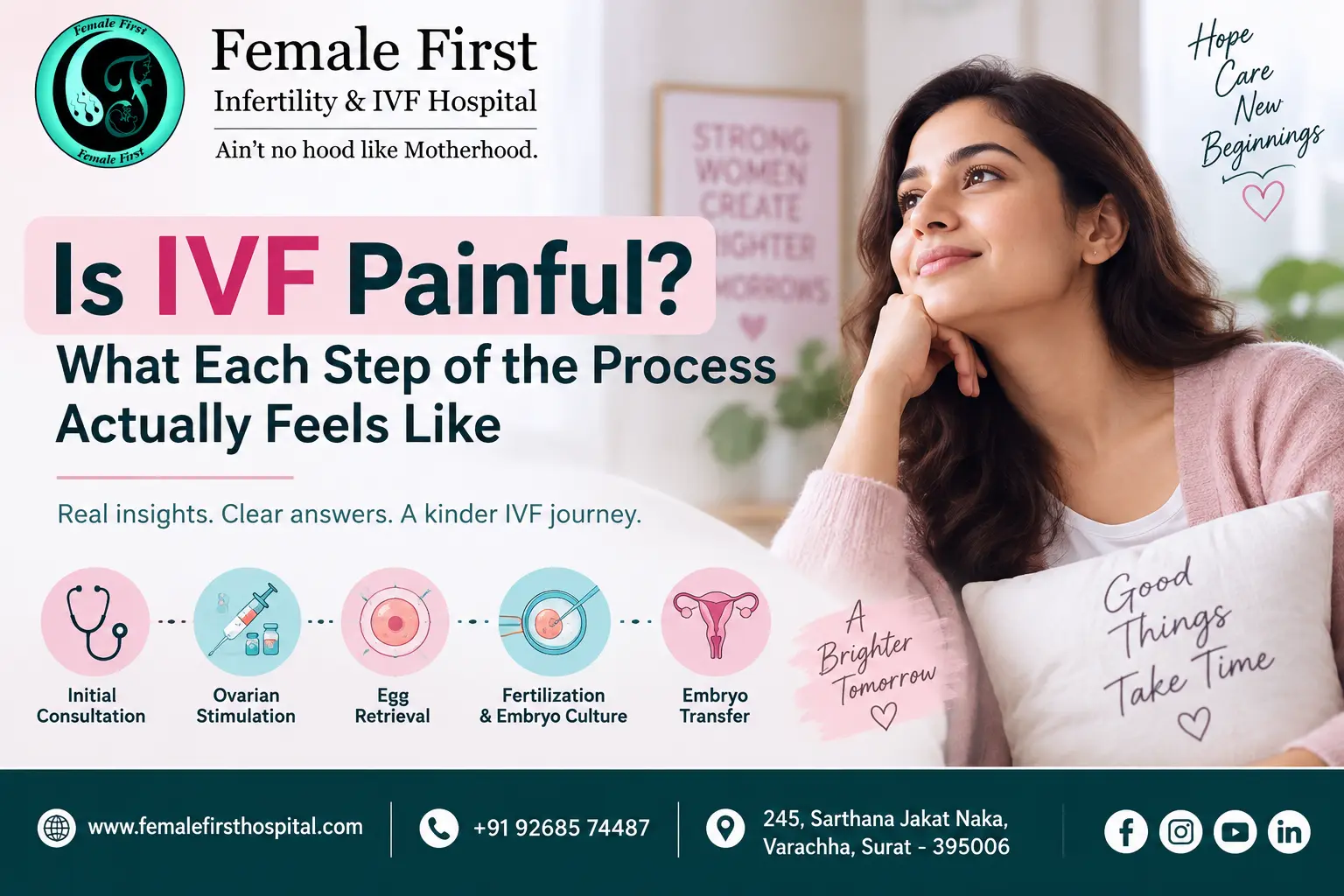
If you are asking “Is IVF painful?” you are not alone. Many people considering fertility treatment worry about injections, procedures and the possibility of discomfort during treatment. The reality is that IVF involves several steps and each person can experience them differently. Some stages may cause mild discomfort, while others are usually painless or involve only brief sensations. Understanding what to expect during IVF treatment can help reduce uncertainty and prepare you mentally and physically for the journey. At Female First IVF Hospital, patients are guided through each stage so they can understand the purpose of every procedure and discuss any concerns with their fertility specialist.
IVF or in vitro fertilisation, is an assisted reproductive treatment in which eggs are collected from the ovaries and fertilised with sperm in a laboratory. An embryo is then transferred into the uterus with the aim of achieving pregnancy. Although the word “procedure” may sound intimidating, the process is carefully planned and monitored by a medical team.
Is IVF Painful? Understanding the Reality
IVF is generally not described as a severely painful treatment. However, discomfort can occur at certain stages. The experience depends on factors such as individual sensitivity, the type of procedure performed and the medications used.
Some people describe IVF injections as similar to a quick pinch. Others may experience bloating or pelvic heaviness during ovarian stimulation. Egg retrieval is performed under appropriate sedation or anaesthesia, so you should not experience significant pain during the procedure itself.
Afterward, you may experience mild cramping or soreness for a short period. Your fertility specialist can advise you about appropriate pain management and tell you which symptoms are normal and which require medical attention.
It is also important to distinguish between pain and discomfort. A procedure may feel uncomfortable without being genuinely painful. Knowing what may happen at every stage can make the experience feel much more manageable.
What to Expect During IVF Treatment: Step-by-Step
Understanding the IVF process before beginning treatment can make the journey less overwhelming. While protocols differ depending on the individual patient, the major stages generally include ovarian stimulation, monitoring, egg retrieval, fertilisation, embryo development and embryo transfer.
1. Initial Consultation and Infertility Testing
Before IVF begins, your fertility specialist will usually review your medical history and reproductive goals. Tests may be recommended to understand ovarian function, hormone levels, sperm health and other factors that could affect conception.
An infertility test in Surat may include blood tests, ultrasound examinations, semen analysis and other assessments depending on your circumstances.
This stage is generally painless, although some tests such as blood collection or certain examinations may cause minor temporary discomfort.
The purpose of these tests is not simply to confirm infertility. They help the doctor understand the underlying factors and determine whether IVF is appropriate or whether another treatment may be more suitable.
2. Ovarian Stimulation and Fertility Injections
During IVF, the ovaries are stimulated with prescribed fertility medications to encourage the development of multiple eggs.
These medications are often administered through injections. For many patients, this is one of the stages they worry about most.
The injections usually involve a small needle and may cause:
- A brief pinching sensation
- Mild soreness at the injection site
- Occasional bruising
- Temporary tenderness
Hormonal stimulation may also cause bloating, breast tenderness or a feeling of fullness in the abdomen.
Your response to medication is monitored through ultrasound scans and sometimes blood tests. Monitoring helps the fertility team adjust treatment when necessary and reduce the risk of complications.
3. Monitoring During Ovarian Stimulation
Regular monitoring is an important part of IVF. Ultrasound scans allow the fertility specialist to observe follicle development and assess how the ovaries are responding to medication.
A transvaginal ultrasound may feel slightly uncomfortable but it is generally a quick procedure. Communicating with your doctor during the examination can help make the experience more comfortable.
The frequency of monitoring depends on your individual treatment plan.
The aim is to identify the appropriate time for egg maturation and retrieval rather than simply increasing the number of eggs produced.
Is Egg Retrieval Painful?
Egg retrieval is often the stage that causes the most concern when patients ask “Is IVF painful?”
During egg retrieval, a thin needle is guided through the vaginal wall toward the ovaries to collect mature eggs from the follicles. The procedure is performed using sedation or anaesthesia according to the clinical protocol and the patient’s needs.
Because you receive appropriate pain control, you should not feel significant pain during the retrieval.
After the procedure, some patients may experience:
- Mild abdominal cramping
- Pelvic discomfort
- Bloating
- Light spotting
- Tiredness
These symptoms are generally temporary. Your medical team will provide post-procedure instructions and explain when you should contact them.
Severe or worsening pain should not simply be assumed to be a normal part of IVF. If you experience significant symptoms after a procedure, you should contact your fertility care team promptly.
Is Fertilisation Painful?
Once the eggs have been retrieved, they are taken to the embryology laboratory. Fertilisation takes place outside the body, so there is no physical sensation associated with this stage.
Depending on the patient’s circumstances, fertilisation may occur through conventional IVF or through ICSI.
ICSI Treatment in Surat
ICSI treatment in Surat may be recommended when certain male infertility factors are present or when previous fertilisation has been unsuccessful.
During ICSI, an embryologist injects a single sperm directly into a mature egg. This happens in the laboratory and therefore does not cause pain to the patient.
The fertilised eggs are then monitored as they develop into embryos.
Embryo Development and the Waiting Period
After fertilisation, the embryos are observed in the laboratory. Depending on their development and the treatment plan, an embryo may be transferred at an appropriate stage.
Some embryos may continue developing until the blastocyst stage.
The embryo development stage does not cause physical pain because it occurs outside the body. However, many patients find the waiting period emotionally challenging.
It is completely understandable to feel anxious while waiting for updates about embryo development. Ask your medical team how and when you will receive information so you know what to expect.
Is Blastocyst Transfer Painful?
A blastocyst transfer in Surat involves placing a selected embryo into the uterus using a thin, flexible catheter.
Unlike egg retrieval, this procedure usually does not require general anaesthesia. For many patients, it feels similar to a routine gynaecological examination.
You may experience:
- Mild pressure
- Temporary cramping
- Slight discomfort during catheter placement
The procedure itself is generally brief.
The catheter is carefully passed through the cervix and the embryo is placed inside the uterus. The embryo transfer does not involve an incision.
After the transfer, you may be advised about medication, activity and follow-up based on your individual treatment plan.
What About Embryo Freezing?
Not every embryo needs to be transferred immediately. In suitable cases, embryos can be cryopreserved for future use.
Embryo freezing in Surat is a laboratory procedure and therefore does not cause physical pain to the patient. The embryos are carefully prepared and stored using specialised cryopreservation techniques.
Frozen embryo transfer may be considered later depending on the patient’s medical circumstances and treatment plan.
This approach can give some patients additional flexibility while planning their fertility treatment.
When IVF May Involve Additional Procedures
IVF does not always involve only the standard treatment pathway. Some patients may require additional evaluation or procedures based on their medical history.
For example, laparoscopic surgery in Surat may be recommended in selected cases to evaluate or treat certain reproductive conditions. Laparoscopy is a minimally invasive surgical procedure and is different from routine IVF procedures.
Whether surgery is necessary depends on the diagnosis. It should not be performed simply because a patient is undergoing IVF.
Your fertility specialist can explain whether an additional procedure may improve your treatment plan and why it has been recommended.
IVF vs IUI: Are the Experiences Different?
Patients sometimes compare IVF with IUI treatment in Surat when deciding which fertility treatment to pursue.
IUI or intrauterine insemination, is generally a simpler procedure than IVF. During IUI, prepared sperm is placed directly into the uterus around the time of ovulation.
The procedure usually causes little discomfort and is completed relatively quickly.
IVF involves ovarian stimulation, egg retrieval, laboratory fertilisation and embryo transfer. Therefore, it is more involved than IUI.
The choice between IUI and IVF should be based on medical factors rather than simply which treatment seems easier. Your fertility specialist can recommend an approach based on your age, diagnosis, reproductive history and other relevant factors.
How Can You Make IVF More Comfortable?
Although you cannot completely control how your body responds to treatment, there are several ways to make the experience more manageable.
Communicate With Your Fertility Team
Tell your doctor if you are worried about needles, procedures or pain. Knowing about your concerns allows the medical team to explain what will happen and discuss appropriate comfort measures.
Follow Medication Instructions Carefully
Take medications exactly as prescribed. Do not change the dosage or stop treatment without speaking to your fertility specialist.
Plan Your Schedule
IVF involves appointments for scans, consultations and procedures. Planning your work and personal schedule in advance can reduce unnecessary stress.
Stay Hydrated and Follow Your Doctor’s Advice
Your doctor may provide specific recommendations regarding hydration, diet, activity and medications during treatment. Follow the instructions given to you rather than relying on general advice from social media.
Prepare Emotionally
Fertility treatment can involve excitement, uncertainty and anxiety. Give yourself permission to experience these emotions. Having a supportive partner, family member or counsellor can also be helpful.
Understanding IVF Through Reliable Information
Online videos and educational resources can help patients understand medical procedures visually. Searches for an IVF process explained video can provide a general overview of what happens during treatment.
However, online content should not replace personalised medical advice. Every IVF cycle is different and treatment protocols can vary considerably between patients.
When researching fertility treatment, always consider the credibility of the source. Information from qualified fertility specialists, established medical organisations and reputable hospitals is generally more reliable than anonymous social media posts or unverified testimonials.
When Should You Speak to a Fertility Specialist?
If you have been trying to conceive without success or have concerns about your reproductive health, it may be appropriate to seek professional evaluation.
You do not necessarily need to proceed directly to IVF. A fertility specialist can first assess your situation and explain whether lifestyle changes, medication, IUI or another treatment may be appropriate.
At Female First IVF Hospital, the consultation process can help patients understand their fertility concerns and the treatment options available to them. The objective should be to recommend a medically appropriate approach rather than assuming IVF is the answer for everyone.
Conclusion: IVF May Involve Discomfort But It Should Not Be a Mystery
So is IVF painful? For most patients, IVF involves some degree of discomfort rather than severe pain. Injections can cause brief pinching or soreness, ovarian stimulation may cause bloating and egg retrieval can lead to temporary cramping. Embryo transfer is generally a short procedure with little discomfort for most patients.
What matters most is knowing what each stage involves and having a qualified fertility team to guide you through it. From initial testing and ovarian stimulation to egg retrieval, fertilisation and embryo transfer, understanding the process can make the journey feel more predictable.
If you are considering IVF treatment in Surat, speak with a qualified fertility specialist about your individual circumstances rather than relying solely on general information available online. At Female First IVF Hospital, informed decision-making and personalised fertility care can help patients approach treatment with greater clarity and confidence.
IVF is a medical treatment and every patient’s experience is different. The right preparation, appropriate medical supervision and open communication with your fertility team can make the process more comfortable and less uncertain.