
📞 +91 9262343434

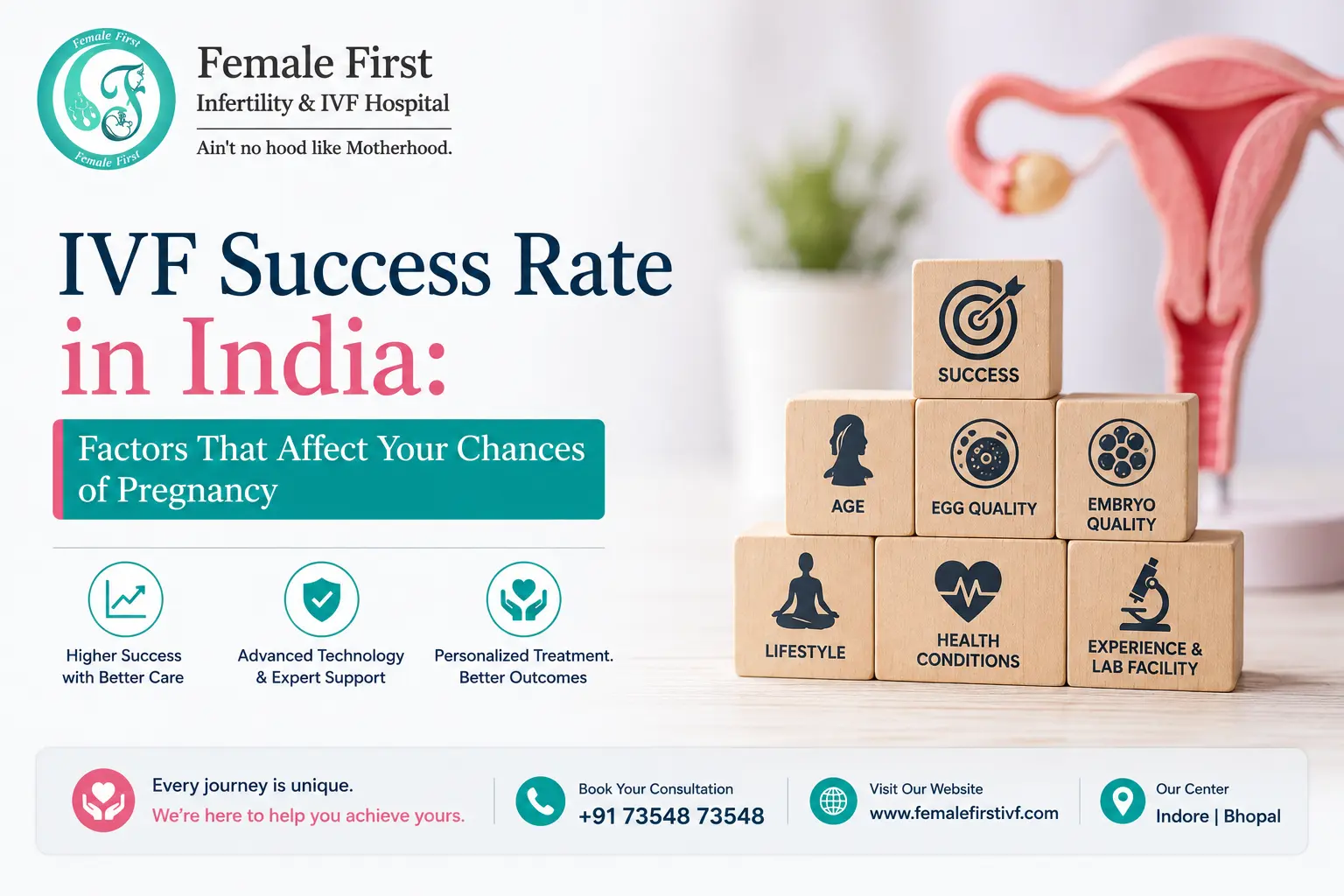
IVF Success Rate in India: Factors That Affect Your Chances of Pregnancy
“Doctor, kitne percent chance hai?” — it is the first question in almost every IVF consultation, and it deserves a straight answer. At well-equipped Indian fertility centres, per-cycle IVF success rates typically look like this:
| Woman’s Age | Success Rate Per Cycle |
|---|---|
| Under 35 | 50–60% |
| 35–40 | 35–45% |
| Above 40 | 15–25% |
India’s numbers have improved dramatically over the past decade, driven by better embryology labs, refined stimulation protocols, and techniques like blastocyst culture becoming standard. But a table like this is a starting point, not a promise — your personal number depends on factors this article will walk through one by one, because understanding them is exactly how couples improve their odds.
First, Understand What “Success Rate” Actually Means
Before comparing clinics, learn to read the fine print, because the same clinic can honestly quote three different numbers:
- Positive pregnancy test rate — the highest number, but includes pregnancies that sadly do not continue
- Clinical pregnancy rate — a pregnancy confirmed on ultrasound with a heartbeat
- Live birth rate — a baby in your arms, the only number that ultimately matters, and always the lowest of the three
When a clinic advertises a very high success rate without saying which definition it uses, or quotes one flat number for all ages, treat it as marketing. An ethical centre will tell you which metric they are quoting, break it down by age group, and then give you a personalised estimate after reviewing your reports. Ask directly: “What is your clinical pregnancy rate per embryo transfer for my age group?” The quality of the answer tells you as much about the clinic as the number itself.
Factor 1: The Woman’s Age — The Single Biggest Variable
Nothing influences IVF success more than the age of the eggs. Egg quantity and quality both decline with time, and the decline steepens after 35 and again after 40 — which is exactly why every serious registry and health body, including the NHS in its IVF guidance, reports success rates in age bands rather than one number. This is biology, not clinic performance.
Two practical conclusions follow. First, if you are struggling to conceive, seek evaluation early — waiting “one more year” at 36 costs more than the same year at 28. Second, age affects egg age specifically: women who froze eggs earlier, or those using donor eggs when medically indicated, see success rates tied to the age at which those eggs were retrieved, not their current age.
Factor 2: The Cause of Infertility
Not all diagnoses carry the same prognosis. Couples whose only issue is blocked fallopian tubes often do very well with IVF, because the treatment completely bypasses the problem while everything else works normally. Ovulation disorders like PCOS also generally respond well once stimulation is tailored correctly.
Other conditions need more strategy. Moderate to severe endometriosis can affect egg quality and implantation, and sometimes benefits from surgical treatment before IVF — this is where laparoscopic surgery in Surat and at advanced endoscopy units plays a supporting role, correcting endometriosis, fibroids, or tubal disease so the IVF cycle starts on cleaner ground. Uterine factors such as polyps, adhesions, or a thin lining reduce implantation chances until addressed. The takeaway: an accurate diagnosis before treatment is not a formality; it decides both your true odds and the plan that maximises them. This is why structured Infertility Treatment in Surat always begins with a complete evaluation of both partners rather than jumping straight to a protocol.
Factor 3: Ovarian Reserve
Age is the average; ovarian reserve is the individual. AMH levels and antral follicle counts tell your doctor how many eggs your ovaries can realistically produce in a cycle. A 32-year-old with low reserve and a 38-year-old with excellent reserve can have very different cycles than their ages alone predict. Reserve mainly affects quantity — how many eggs are retrieved — which shapes how many embryos you get to work with and whether spare embryos can be frozen. Low reserve does not mean IVF cannot work; it means protocols must be individualised, and expectations set on your numbers, not on generic tables.
Factor 4: Sperm Quality — The Half That Gets Ignored
Sperm contributes half of every embryo’s genetics, and sperm problems contribute to infertility in nearly half of couples, as the World Health Organization documents. Count, motility, morphology, and DNA integrity all influence fertilisation and embryo development.
The good news is that modern IVF has an answer for almost every level of male factor. Moderate issues are handled by ICSI treatment in Surat and at advanced labs, where a single healthy sperm is injected into each egg. Even men with no sperm in the ejaculate can often father children, because sperm can frequently be retrieved directly from the testes through procedures like TESE treatment in Surat centres and used with ICSI. What technology cannot do is compensate for poor sperm DNA quality caused by smoking and lifestyle — which is why the three-month preparation window applies to men just as strictly as to women.
Factor 5: Embryo Quality and the Lab That Grows It
Once eggs and sperm meet, the embryology lab becomes the most important room in the hospital. Culture conditions, incubator stability, air quality, and the embryologist’s skill determine whether good gametes become good embryos. Extended culture to day five allows the strongest embryos to identify themselves — the reason blastocyst transfer in Surat and at quality labs worldwide has become central to modern success rates, letting the team transfer one excellent embryo instead of guessing among day-three embryos.
This is also the factor patients can least see and most need to ask about. When evaluating a centre, ask about the IVF hospital infrastructure in Surat clinics you are considering: does the centre have an in-house embryology lab or outsource it, who leads the lab, what incubation and air-filtration systems are used. A clinic that answers these questions proudly and specifically is a clinic that has invested where it counts. The Mayo Clinic’s IVF overview makes the same underlying point: IVF is as much a laboratory discipline as a clinical one.
Factor 6: The Uterus and Implantation
A perfect embryo still needs a receptive home. Endometrial thickness and pattern, the absence of polyps and adhesions, and correct hormonal preparation all influence whether implantation occurs. This is where careful monitoring before transfer pays off, and where unexplained implantation failure prompts further evaluation — hysteroscopy to inspect the cavity, or a switch to a frozen transfer cycle where the uterus can be prepared without stimulation hormones in the background.
Factor 7: Lifestyle — The Factor Entirely in Your Hands
Smoking, alcohol, obesity or being significantly underweight, chronic sleep deprivation, and unmanaged stress each chip away at egg quality, sperm quality, and implantation. None of them is as decisive as age, but together they are the difference between arriving at your cycle prepared or handicapped — and they are the only major factor you fully control. We have written a complete, practical guide to the lifestyle changes that improve IVF success, built around the three-month window in which eggs and sperm mature. If your cycle is more than three months away, that article is your to-do list.
Factor 8: Thinking in Cycles, Not in One Attempt
Per-cycle rates tell only half the story. Cumulative success — your chances across two or three attempts — is substantially higher than any single cycle’s number, which reframes how to plan both emotionally and financially. This is also where freezing changes the math: spare embryos preserved through embryo freezing in Surat labs turn one stimulation into multiple transfer opportunities, each at a fraction of a fresh cycle’s cost and physical demand. Couples who plan for the journey rather than a single roll of the dice consistently cope better — something we explore in our guide to the emotional journey of IVF — and, statistically, most couples who persist through the recommended attempts do succeed.
How to Actually Improve Your Chances: A Practical Checklist
- Get evaluated early and completely — both partners, before any treatment decision.
- Correct what is correctable first — thyroid issues, vitamin deficiencies, uterine polyps, untreated endometriosis.
- Use the three-month window — no tobacco, no alcohol, better sleep, moderate exercise, sensible diet, for both partners.
- Choose your centre on lab quality and honesty, not on advertised percentages. Meet the team, see the facility, and spend time understanding the process — our IVF process explained video content walks you through each stage so nothing feels unknown.
- Follow the protocol exactly — medication timing matters more than patients realise.
- Plan for more than one attempt from the start, financially and emotionally, and freeze spare embryos.
- Stay guided by your own numbers. Your AMH, your scan, your semen analysis — under the care of an experienced fertility specialist and the best gynecologist in Surat or your own city that you can access — beat every generic statistic on the internet, including the ones in this article.
Frequently Asked Questions
Can any clinic guarantee IVF success?
No, and any centre promising 100% success or “guaranteed baby” packages without transparent terms should raise immediate caution. Biology involves probability at every step. What a good clinic guarantees is honest counselling, a personalised protocol, and full effort at every stage.
Why did my IVF fail even with good-quality embryos?
Embryo grading assesses appearance, not genetics — a good-looking embryo can still carry chromosomal issues, which is the most common reason for failed implantation, especially with increasing age. Other causes include uterine receptivity and timing factors. One failed cycle with good embryos is disappointing but common, and it gives your doctor concrete information; recurrent failure prompts deeper testing, sometimes including genetic testing of embryos.
Is the success rate lower with frozen embryo transfer?
No — with modern vitrification, frozen transfers match fresh transfer outcomes, and in some patients doctors deliberately prefer them because the uterus can be prepared in a calmer hormonal environment. Freezing is a tool that adds attempts, not a compromise that weakens them.
How many IVF cycles does it typically take to conceive?
Many couples conceive in the first cycle; a large share of the remainder succeed by the second or third. Most specialists suggest evaluating the approach freshly after three unsuccessful full cycles rather than repeating the identical plan. Your age band and diagnosis shape the realistic expectation, which is a first-consultation conversation, not a Google search.
Does IVF work after 40?
Yes, but with honest numbers: per-cycle rates of roughly 15–25% with own eggs, declining year by year. Options like embryo genetic testing, or donor eggs where appropriate and chosen by the couple, can meaningfully change the picture. After 40, the most expensive mistake is delay — evaluation this month beats evaluation next year, every time.
Your Number Is Personal — Go Get It
Averages describe populations; your chances depend on your age, your reserve, your reports, and the lab you choose. The couples who navigate IVF best are the ones who replace internet statistics with their own personalised assessment early, prepare for a journey of attempts rather than a single event, and pick their centre for its lab, its honesty, and its people.
That personalised number is one consultation away. Book an IVF consultation in Surat at Female First Hospital, bring both partners’ reports if you have them, and our team will give you a realistic, age-and-diagnosis-specific picture of your chances — along with the exact plan to make the most of them.