
📞 +91 9262343434

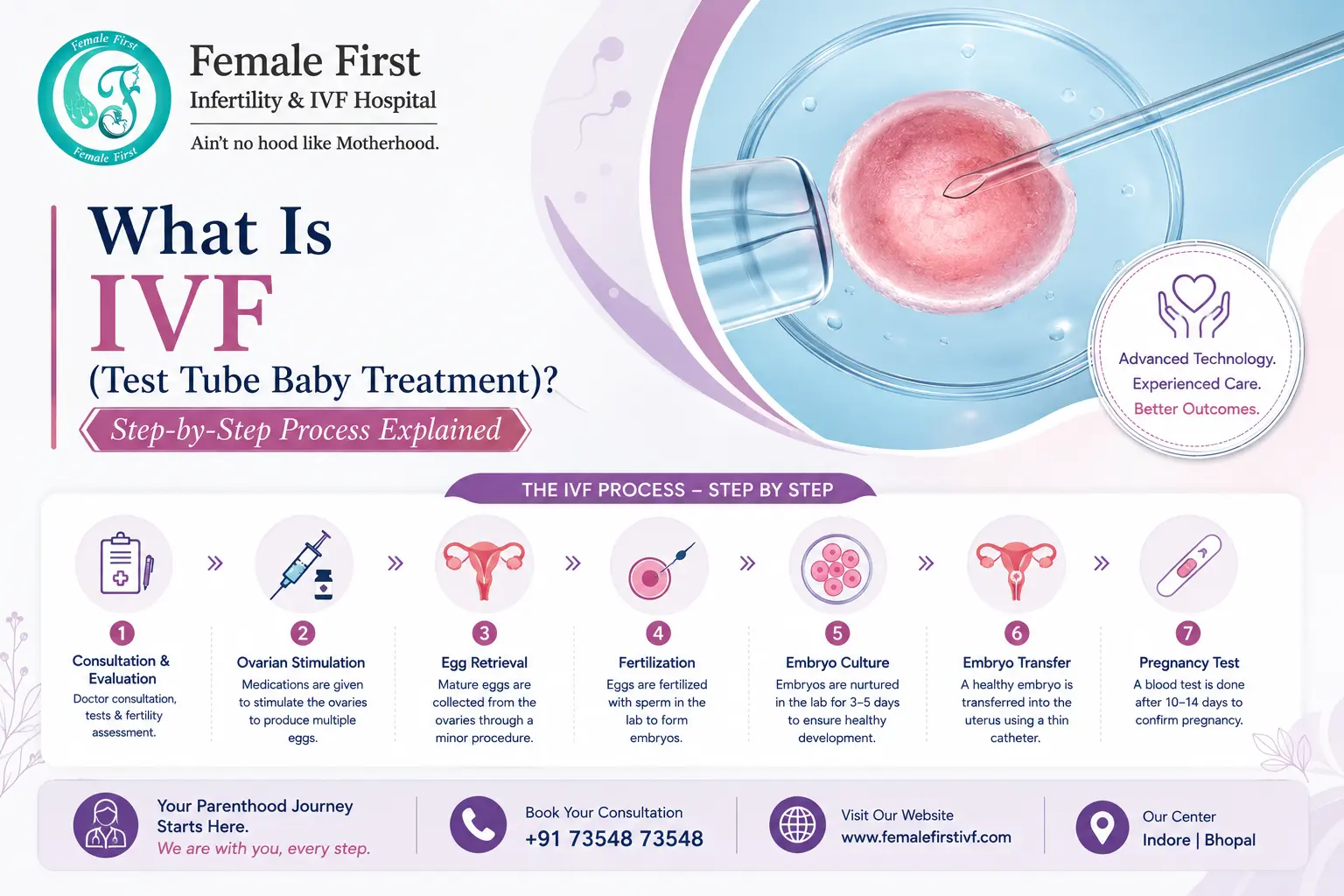
In vitro fertilisation — IVF, or in everyday Indian usage, test tube baby treatment — is the process of fertilising an egg with sperm in a laboratory and placing the resulting embryo into the uterus to establish a pregnancy. The name “test tube baby” is a relic from the 1970s headlines; no tube is involved and no baby grows in a lab. Fertilisation happens in a culture dish over a few days, and everything after the embryo transfer is an ordinary pregnancy: same nine months, same delivery, same baby.
What makes IVF feel intimidating is not the medicine — it is the unknown. Couples fear what they cannot picture. So this guide walks through the entire process step by step, with what actually happens, how long each stage takes, and what you will feel along the way, because understanding what to expect during IVF treatment is the single best cure for the fear around it.
The Big Picture: How Long Does One IVF Cycle Take?
From the day stimulation injections begin to the pregnancy blood test, one IVF cycle takes roughly 4 to 6 weeks. Add the evaluation and preparation phase before it, and most couples go from first consultation to pregnancy test in about two to three months. It is a sprint of appointments in the middle weeks, but the majority of the process fits around a normal working life.
Here is the journey, stage by stage.
Step 1: Consultation, Testing, and Your Personalised Plan
Everything begins with understanding your specific situation. Both partners are evaluated: hormone profiles and ovarian reserve testing (AMH) for the woman, semen analysis for the man, pelvic ultrasound, and a detailed medical history. This work-up typically completes within one menstrual cycle.
The results decide everything that follows — the medication protocol, the doses, and whether additional techniques will be needed. This is why two patients at the same clinic can have quite different treatment plans: IVF done properly is individualised, not off-the-shelf. It is also the stage where your doctor confirms IVF is actually the right treatment for you rather than something simpler — a decision framework we have explained in our guide on how to choose IVF or IUI treatment.
Step 2: Ovarian Stimulation (8–14 Days)
In a natural cycle, the ovaries mature one egg per month. IVF needs more to work with, so for 8 to 14 days the woman takes hormone injections that encourage a group of eggs to mature together. These are the same hormones the body already produces, given in controlled doses.
Two things surprise patients here. First, the injections are far easier than imagined — fine needles in pen-style injectors, self-administered at home in the thigh or abdomen after one demonstration. Second, the monitoring is frequent: every few days you visit for an ultrasound and blood test so the doctor can watch follicle growth and adjust doses. Expect three to five short visits during this phase. Some women feel bloating or mood changes from the hormones; both are temporary and expected.
When the follicles reach the right size, a final “trigger injection” is given at a precisely scheduled time — usually late evening — and egg retrieval is booked for about 36 hours later. That timing is exact for a reason: it catches the eggs at peak maturity, just before the body would release them on its own.
Step 3: Egg Retrieval (20–30 Minutes, Under Anaesthesia)
This is the step people fear most and the one that consistently proves gentler than expected. Under short anaesthesia — you are asleep and feel nothing — the doctor uses ultrasound guidance to pass a fine needle through the vaginal wall into each ovary and draw the fluid from each follicle. The embryology team immediately examines the fluid and counts the eggs.
The whole procedure takes 20 to 30 minutes. You rest for a couple of hours, go home the same day, and most women resume light routine by the next day, with some cramping and spotting that settles quickly. There are no cuts and no stitches.
Step 4: Sperm Collection and Fertilisation — The Same Day
While the eggs are being retrieved, the male partner provides a semen sample (frozen or surgically retrieved sperm is used when needed — men with obstructive azoospermia, for example, can have sperm collected through procedures like TESA treatment in Surat beforehand). The lab washes and prepares the sample, selecting the healthiest sperm.
Fertilisation then happens one of two ways:
- Conventional IVF: prepared sperm are placed with each egg in a culture dish, and fertilisation occurs on its own overnight.
- ICSI: when sperm count or quality is low, the embryologist injects a single selected sperm directly into each egg. ICSI treatment in Surat and at advanced labs worldwide has made fatherhood possible for men whose reports once seemed hopeless.
The next morning, the lab checks how many eggs fertilised — your first result of the cycle, usually shared with you the same day.
Step 5: Embryo Culture (3–5 Days in the Lab)
Fertilised eggs now grow in precisely controlled incubators, and the embryology team monitors their division day by day: two cells, four, eight, and — by day five — a blastocyst, the stage at which the embryo has organised itself and the strongest candidates have identified themselves. Growing embryos to day five for blastocyst transfer in Surat labs and modern centres everywhere allows the single best embryo to be chosen, which supports better success per transfer while reducing twin risk.
Expect the numbers to shrink at each stage — ten eggs might give seven fertilised, and four or five strong embryos. This attrition is normal biology, not a failing cycle; it is the same natural selection that happens invisibly inside the body every month.
Step 6: Embryo Transfer (Simple, Painless, No Anaesthesia)
The selected embryo is loaded into a thin, soft catheter and placed into the uterus under ultrasound guidance. The procedure takes minutes, feels similar to a routine gynaecological exam, and needs no anaesthesia — many couples watch the moment on the ultrasound screen. You walk out the same hour.
Healthy spare embryos are not wasted: they can be preserved through embryo freezing in Surat labs using modern vitrification, giving you future attempts — or a second child years later — without repeating stimulation and retrieval. Freezing is one of the smartest decisions in the entire process, medically and financially, as we detailed in our IVF cost breakdown.
And no — you do not need bed rest afterwards. Normal light activity resumes immediately; only intense exercise and heavy lifting wait.
Step 7: The Two-Week Wait and the Pregnancy Test
About 10 to 14 days after transfer, a blood test (beta hCG) confirms whether implantation occurred. These two weeks are famously the hardest part of IVF — not physically, but mentally. Progesterone support medication continues, its side effects mimic early pregnancy symptoms, and every twinge invites over-analysis. Resist home testing before the scheduled date; early results mislead in both directions. We have written a full guide to surviving this phase in the emotional journey of IVF, and it is worth reading before your transfer, not after.
A positive test leads to repeat blood work and an ultrasound a few weeks later to confirm the heartbeat, after which care transitions to a normal pregnancy. A negative result, painful as it is, is followed by a detailed review — what the cycle revealed, and how the next attempt, often a far simpler frozen embryo transfer, can be improved. Understanding the factors that affect IVF success rates from the start helps couples treat IVF as a journey of attempts rather than a single verdict.
Why Doctors Recommend IVF
IVF is the treatment of choice for blocked or damaged fallopian tubes, significant male infertility, endometriosis, PCOS that has not responded to simpler treatment, unexplained infertility, age-related decline, and couples needing genetic testing of embryos — we have mapped each situation in detail in who should consider IVF. Globally, infertility touches roughly one in six adults according to the World Health Organization, and IVF — practised and refined for over 45 years, as neutral references like the Mayo Clinic and the NHS describe — remains its most powerful answer.
Frequently Asked Questions
Is the IVF process painful?
Far less than feared. Injections use very fine needles, egg retrieval happens under anaesthesia while you sleep, and embryo transfer is typically painless. Most patients describe the process as tiring and emotionally demanding rather than physically painful.
Do I need to be admitted to the hospital?
No. Every step of IVF is an outpatient procedure — even egg retrieval sends you home the same day after a short rest. There is no overnight stay in a standard cycle.
Can I continue working during IVF treatment?
Yes, most patients work throughout, planning around the monitoring visits and taking one or two days easy around egg retrieval. Discuss your schedule with your clinic; visits can often be timed to early mornings.
How many embryos are transferred?
Modern practice favours transferring one high-quality embryo — especially a day-five blastocyst — to maximise safety and keep twin risk low, with spare embryos frozen for later. Your doctor will recommend the number based on your age, embryo quality, and history.
What happens to the embryos we don’t use?
They remain safely frozen in storage for your future use — a second attempt if needed, or a sibling years later. Storage continues year to year for a fee, and decisions about them always remain with you, governed by India’s ART regulations.
See the Process, Then Start Yours
Reading about IVF removes half the fear; seeing it removes the rest. Watch our IVF process explained video walkthroughs to see the journey stage by stage, and when you are ready to know what your cycle would look like — your protocol, your timeline, your realistic chances — sit down with our team at Female First Hospital, a dedicated test tube baby hospital in Surat providing complete IVF treatment in Surat under one roof. Book an IVF consultation in Surat, and turn the unknown into a plan.