
📞 +91 7879872580
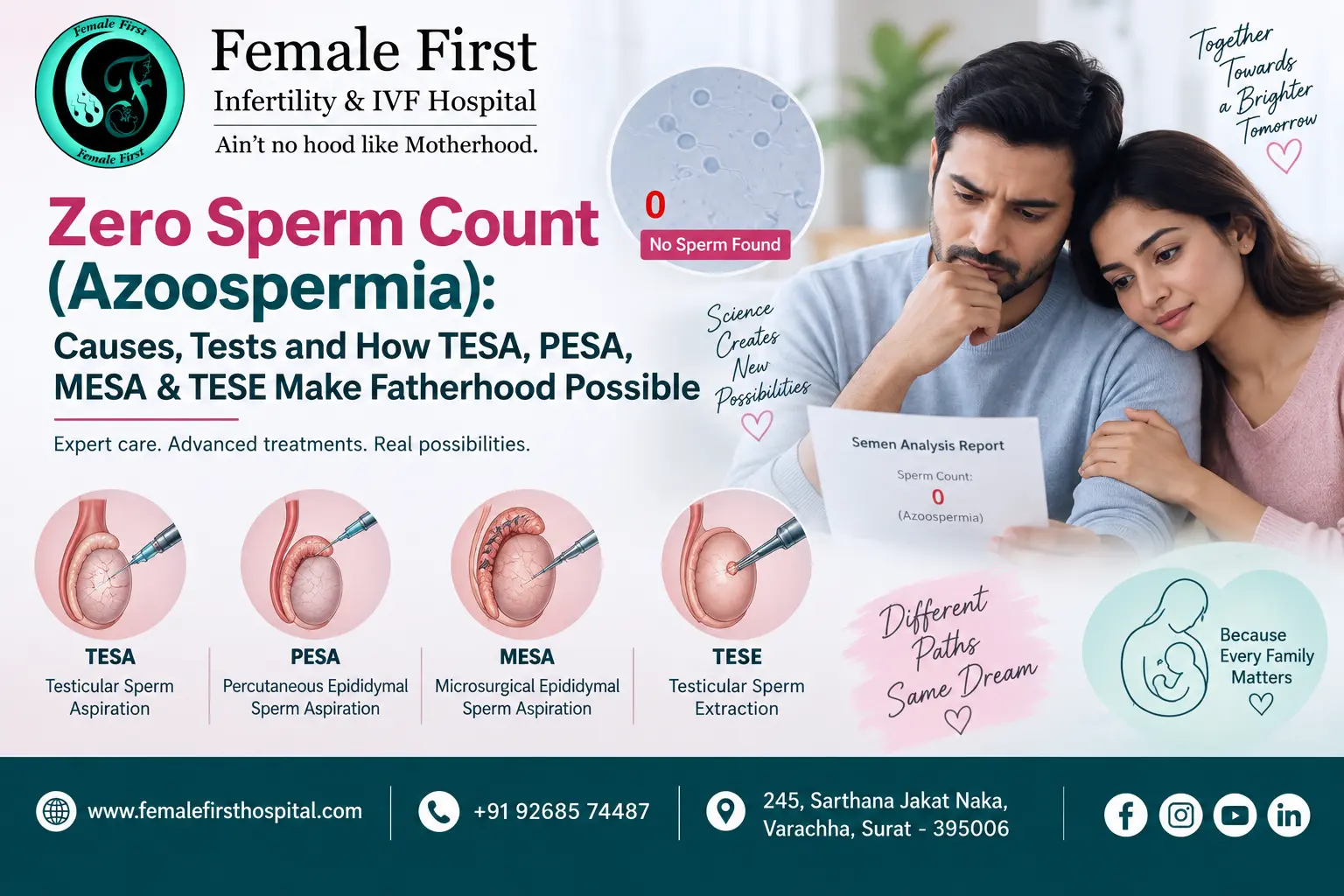
A diagnosis of zero sperm count can be deeply concerning for a couple trying to conceive. However, azoospermia does not always mean that biological fatherhood is impossible. With appropriate evaluation and azoospermia treatment, many men may have options for retrieving sperm directly from the reproductive tract or testicular tissue. Techniques such as TESA, PESA, MESA and TESE can sometimes help doctors obtain sperm for use with ICSI. Understanding the cause of azoospermia is the first and most important step because treatment depends on whether sperm production is affected or sperm is being blocked from reaching the semen. At Female First IVF Hospital, patients can discuss their diagnosis and available fertility treatment options with a qualified reproductive care team.
What Is Azoospermia?
Azoospermia means that no sperm are detected in the semen during a semen analysis. It is different from having a very low sperm count because the laboratory does not identify sperm in the ejaculate.
Azoospermia can be caused by problems with sperm production or by an obstruction that prevents sperm from reaching the semen. These two broad categories are commonly described as:
Obstructive azoospermia: The testes may produce sperm but a blockage prevents the sperm from entering the ejaculate.
Non-obstructive azoospermia: The main problem is reduced or absent sperm production within the testes.
Determining which type is present is important because it influences the diagnostic process and the treatment options that may be considered.
What Causes Zero Sperm Count in Men?
Azoospermia can have several possible causes. Sometimes the cause is relatively straightforward to identify, while in other cases several factors may need to be investigated.
Possible causes include:
- Blockage in the reproductive tract
- Previous infections or inflammation
- Previous surgery involving the reproductive system
- Hormonal disorders
- Genetic conditions
- Testicular injury
- Problems affecting testicular function
- Certain medications
- Previous cancer treatment such as chemotherapy or radiation
- Conditions affecting sperm production
- Congenital absence or abnormalities of parts of the reproductive tract
Lifestyle factors may also affect overall reproductive health but they are not the explanation for every case of azoospermia. A proper medical evaluation is therefore essential before assuming what caused the condition.
How Is Azoospermia Diagnosed?
A diagnosis of azoospermia should not generally be made from a single semen analysis alone. Your fertility specialist may recommend repeating the semen analysis under appropriate laboratory conditions to confirm the finding.
The evaluation may include medical history, physical examination, hormone testing and additional investigations depending on the suspected cause.
Infertility Test in Surat: What May Be Included?
An infertility test in Surat for a man with suspected azoospermia may involve several assessments rather than one individual test.
These may include:
- Semen analysis
- Hormonal testing
- Physical examination
- Scrotal or testicular ultrasound when indicated
- Genetic testing in selected cases
- Evaluation of previous surgeries or infections
- Assessment of testicular size and reproductive anatomy
Hormonal tests can provide information about the signals involved in sperm production. Genetic testing may be recommended for certain men with severe sperm production problems because some genetic conditions can contribute to azoospermia.
The exact tests required depend on the individual diagnosis. A fertility specialist should determine which investigations are clinically appropriate.
Can Azoospermia Be Treated?
The answer depends largely on the underlying cause.
If azoospermia is caused by an obstruction, then in selected cases the blockage may be surgically treated or sperm may be retrieved directly from the reproductive tract.
If sperm production is severely reduced, then sperm retrieval from testicular tissue may sometimes provide an option for assisted reproduction.
Hormonal treatment may also be appropriate for certain men when a specific hormonal cause is identified.
This is why azoospermia treatment should begin with diagnosis rather than immediately moving to a procedure. The objective is to identify the reason for the absence of sperm and then choose the most suitable approach.
TESA Treatment in Surat: Retrieving Sperm From the Testis
TESA treatment in Surat refers to testicular sperm aspiration. In this procedure, a fine needle is used to aspirate tissue or fluid from the testis to retrieve sperm.
TESA may be considered in selected patients where sperm retrieval from the testis is appropriate. The retrieved material is examined by an embryology laboratory to determine whether viable sperm are available for assisted reproduction.
One important advantage of sperm retrieval techniques is that sperm does not necessarily need to be present in the ejaculate for biological fatherhood to remain a possibility.
However, TESA is not appropriate for every man with azoospermia. The choice depends on factors such as whether azoospermia is obstructive or non-obstructive and the likelihood of finding usable sperm.
PESA Treatment in Surat: Sperm Retrieval From the Epididymis
PESA treatment in Surat stands for percutaneous epididymal sperm aspiration. The epididymis is a structure attached to the testicle where sperm mature and are stored.
During PESA, a needle is used to aspirate sperm from the epididymis. This technique is generally considered in situations where sperm production is present but an obstruction prevents sperm from appearing in the semen.
If suitable sperm are obtained, they can potentially be used for assisted reproductive treatment such as ICSI.
PESA is different from TESA because the sperm is retrieved from the epididymis rather than directly from testicular tissue.
MESA Treatment in Surat: Microsurgical Epididymal Sperm Aspiration
MESA treatment in Surat stands for microsurgical epididymal sperm aspiration.
MESA involves a microsurgical approach to access the epididymis and retrieve sperm. It may be considered particularly in men with obstructive azoospermia where sperm production is expected to be present.
The procedure is performed under appropriate anaesthesia and involves a specialist surgical team. Because it is more technically involved than some needle-based retrieval techniques, the decision to use MESA depends on the patient’s specific reproductive condition.
The retrieved sperm may then be processed by the embryology team for use in assisted reproduction.
TESE Treatment in Surat: Retrieving Sperm From Testicular Tissue
TESE treatment in Surat stands for testicular sperm extraction. Rather than using a needle alone, TESE involves obtaining a small sample of testicular tissue to look for sperm.
TESE may be considered in selected cases of azoospermia, particularly when sperm production is severely reduced and sperm retrieval directly from the testicular tissue may provide a possibility of finding sperm.
In some situations, more targeted testicular sperm retrieval techniques may be considered based on the patient’s diagnosis and previous treatment history.
The goal is not simply to retrieve tissue. The laboratory examines the sample carefully to identify viable sperm that could potentially be used for assisted reproduction.
How ICSI Helps When Sperm Count Is Zero
When sperm are retrieved through TESA, PESA, MESA or TESE, the number of sperm available may be limited. This is where ICSI can play an important role.
ICSI Treatment in Surat
ICSI treatment in Surat involves injecting a single sperm directly into a mature egg using specialised laboratory equipment.
Unlike conventional IVF fertilisation, where sperm are placed around an egg and fertilisation occurs without direct injection, ICSI gives the embryologist the ability to introduce an individual sperm into the egg.
This can be particularly relevant when sperm numbers are extremely low or when surgically retrieved sperm are being used.
The retrieved sperm does not automatically guarantee fertilisation or pregnancy. The outcome depends on several factors including sperm quality, egg quality, maternal age, embryo development and other individual circumstances.
What Happens After Sperm Retrieval?
Once sperm have been retrieved, the fertility team determines whether they are suitable for use in assisted reproduction.
If eggs are also available, the treatment may proceed toward fertilisation using IVF with ICSI.
IVF Treatment in Surat
IVF treatment in Surat involves stimulating the ovaries to develop eggs followed by egg retrieval. The eggs are then fertilised in the laboratory and the resulting embryos are monitored for development.
When surgically retrieved sperm are used, the ICSI technique is commonly considered because only a limited number of sperm may be available.
The resulting embryos may be transferred into the uterus at an appropriate stage based on the treatment plan.
Embryo Freezing in Surat: Preserving Suitable Embryos
Not every embryo needs to be transferred immediately. When suitable embryos are available, they may be cryopreserved for future use.
Embryo freezing in Surat involves preserving embryos under controlled laboratory conditions using modern cryopreservation techniques.
Embryo freezing may provide flexibility in treatment planning. For example, an embryo may be frozen for later transfer if a fresh transfer is not recommended or if additional embryos remain after a treatment cycle.
The fertility team can explain whether embryo freezing is appropriate based on embryo development and the individual treatment plan.
Does Azoospermia Mean Biological Fatherhood Is Impossible?
Not necessarily.
This is one of the most important points for men receiving an azoospermia diagnosis. The absence of sperm in the ejaculate does not automatically mean that sperm cannot be found elsewhere in the reproductive system.
In cases of obstructive azoospermia, the testes may continue to produce sperm even though the sperm cannot reach the semen. In selected cases, sperm retrieval can therefore provide an opportunity to use the man’s own sperm for assisted reproduction.
Even in some cases of non-obstructive azoospermia, sperm production may occur in small areas of the testicular tissue. Specialist evaluation is necessary to determine whether retrieval may be possible.
The likelihood of finding sperm varies considerably between individuals. No fertility centre should promise a successful retrieval before completing the appropriate medical evaluation.
Choosing the Right Fertility Specialist for Azoospermia
Azoospermia often requires coordinated care between a fertility specialist, urologist or reproductive surgeon and embryology team.
When looking for the best IVF doctor in Surat for male infertility concerns, consider the doctor’s experience with severe male factor infertility and sperm retrieval procedures rather than focusing only on general IVF experience.
You may want to understand:
- How the cause of azoospermia will be investigated
- Whether male infertility specialists are involved when required
- Which sperm retrieval techniques are available
- How the embryology laboratory handles surgically retrieved sperm
- Whether ICSI is available
- How treatment costs are explained
- What alternatives exist if sperm retrieval is unsuccessful
Good fertility care should involve realistic counselling. A specialist should explain the potential benefits, limitations and risks of each approach so that you can participate in treatment decisions.
Why Early Evaluation Matters
Azoospermia can be emotionally difficult to discuss but delaying evaluation may not provide any benefit. Identifying the underlying cause can open the door to appropriate treatment options.
Men should avoid self-prescribing supplements or hormonal medications based on online recommendations. Some treatments that are marketed for improving male fertility may not be appropriate for someone with azoospermia and certain hormonal medications can actually interfere with sperm production.
Professional assessment is especially important when there is a history of testicular surgery, undescended testes, infections, hormonal problems or previous cancer treatment.
Conclusion: Azoospermia Can Have Treatment Options
A diagnosis of zero sperm count can initially feel like the end of the road but it does not always mean that biological fatherhood is out of reach. The right approach begins with identifying why sperm are absent from the semen.
Depending on the cause and individual circumstances, techniques such as TESA, PESA, MESA or TESE may provide a way to retrieve sperm. Retrieved sperm can potentially be used with ICSI to fertilise eggs as part of an IVF treatment plan.
If you are exploring azoospermia treatment or considering IVF treatment in Surat, it is important to seek evaluation from an experienced fertility specialist rather than relying on assumptions based on a semen report alone.
At Female First IVF Hospital, the fertility team can assess the underlying factors contributing to male infertility and discuss appropriate assisted reproductive options based on individual medical needs. With advances in sperm retrieval and reproductive medicine, there may be more possibilities than you initially expect.
Azoospermia is a medical diagnosis that requires personalised evaluation. The most appropriate treatment depends on the cause of the condition and the overall reproductive health of both partners. Seeking timely specialist guidance can help you understand your options and make informed decisions about the next step in your fertility journey.